
Calculate your waste emissions
Answers should be based on your household's waste patterns
Scroll down to see your results ⇩
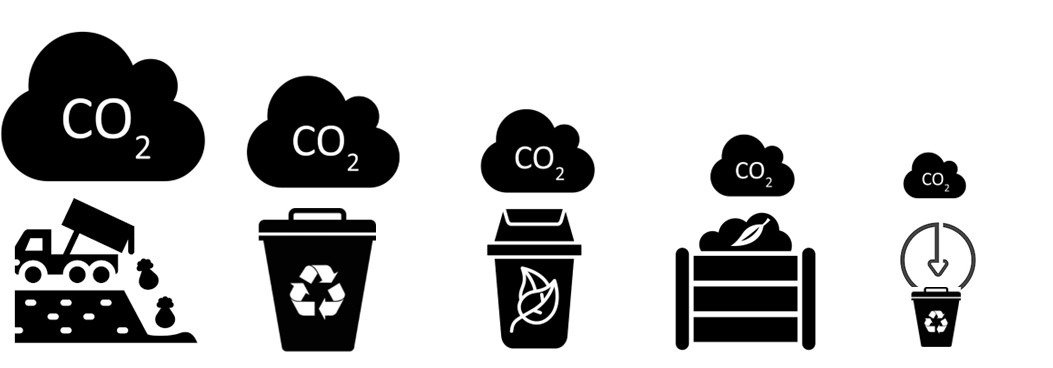
How does how we deal with waste affect CO2 footprint?
CO2 equivalent emissions from household waste in Ireland in 2019 were about 5.3 million tonnes, or [1]1.0 tCO2eq per person.We need to reduce our waste carbon impacts by approximately 1.3 million tCO2eq, to a total of 3.9 million tCO2eq by 2025, to achieve our sustainability targets [2]. This means we should target about a 700 kgCO2 eq footprint for our waste
Not all waste is the same
Waste from some sources has a much higher CO2 eq impact by weight than others. At a minimum, we need to focus on
- Textile waste: we should aim to reduce by 30%
- Plastic waste: We should aim to reduce by 40%
- Food waste: We should aim to reduce by 20%
Most of the time reducing waste means saving money. If you bought 30% more textiles each year you'd be buying less clothes.
Some Useful Links:
Focus on Textile Waste
Not all waste is the same. For example, plastic waste is responsible for about 3kg CO2 eq per kilo of waste. For cardboard containers it is 1.8 C02 eq per kg - [3] for textiles it's vastly higher
| Fibre Type | CO2 eq per kg Clothing |
| Cotton | 24 |
| Wool | 42 |
| Silk | 21 |
| Flax / linen | 11 |
| Viscose | 26 |
| Polyester | 17 |
| Acrylic | 34 |
| Polyamide | 20 |
| Polyurethane | 16 |
| Adapted from Source [4] | |
Waste reduction is where acting with others in your community can really pay
Think about these two situations:
Seán decides that he's going to increase sustainability by reducing his waste. He stops buying takeaway food because the food comes in plastic packaging. He saves himself €20 euro a week. He avoids 1kg of plastic waste a year: that's three kgs of CO2 avoided per year. He's happy
Kate also notices that her local takeaway packages all it's food in plastic. She likes takeaways and doesn't want to give them up. She talks to her friends and relatives and then goes to the takeaway owner to say that most people would prefer if they used compostable packaging. The owner does a bit of customer research and finds Kate is right. The compostable packaging costs an extra 5c per item which the owner passes on to the customer explaining the change. Kate still eats takeaway, but her action has saved 100kgs of packaging waste: that's 300kg of CO2 eq.
Are you a Seán or a Kate? In the results section at next step, we'll give you some examples of what you can do to help reduce waste in your community